How to Localize a YouTube Title for an International Audience
If you have been building a channel for an English-speaking audience and it refuses to move, the problem is often not the footage and not the thumbnail. It is one line of text almost every beginner treats as an afterthought: the title.
I have spent nine years on YouTube, most of that time building faceless channels aimed at viewers who do not speak my first language. In that time the title has become the piece I rewrite most, argue about most, and get the most out of.
Why the same video can perform two different ways
There was a period where I ran a deliberately boring experiment. I took a video that was already published and left it almost entirely alone. Same thumbnail. Same footage. Same description. The only thing I changed was the title.
What happened was not a miracle, and I am not going to quote you numbers, because a single video on a single channel proves nothing you can repeat. But the direction was consistent enough that it changed how I work: click-through improved, watch time held steadier, and the revenue per thousand views moved with it.
Two things clicked into place for me that week:
- A title does not only persuade someone to click.
- A title tells YouTube which group of people to show the video to in the first place.
That second one is the part people miss. The wording of your title is a request for an audience. Write it badly and you get the wrong room.
Localization is not translation
Plenty of creators open a translation tool, convert their title from their own language into English, upload, and consider the job done. It rarely is.
A translated title is grammatically correct. A localized title is the phrasing that audience already uses. Those are not the same object, and the gap between them is where most channels quietly stall.
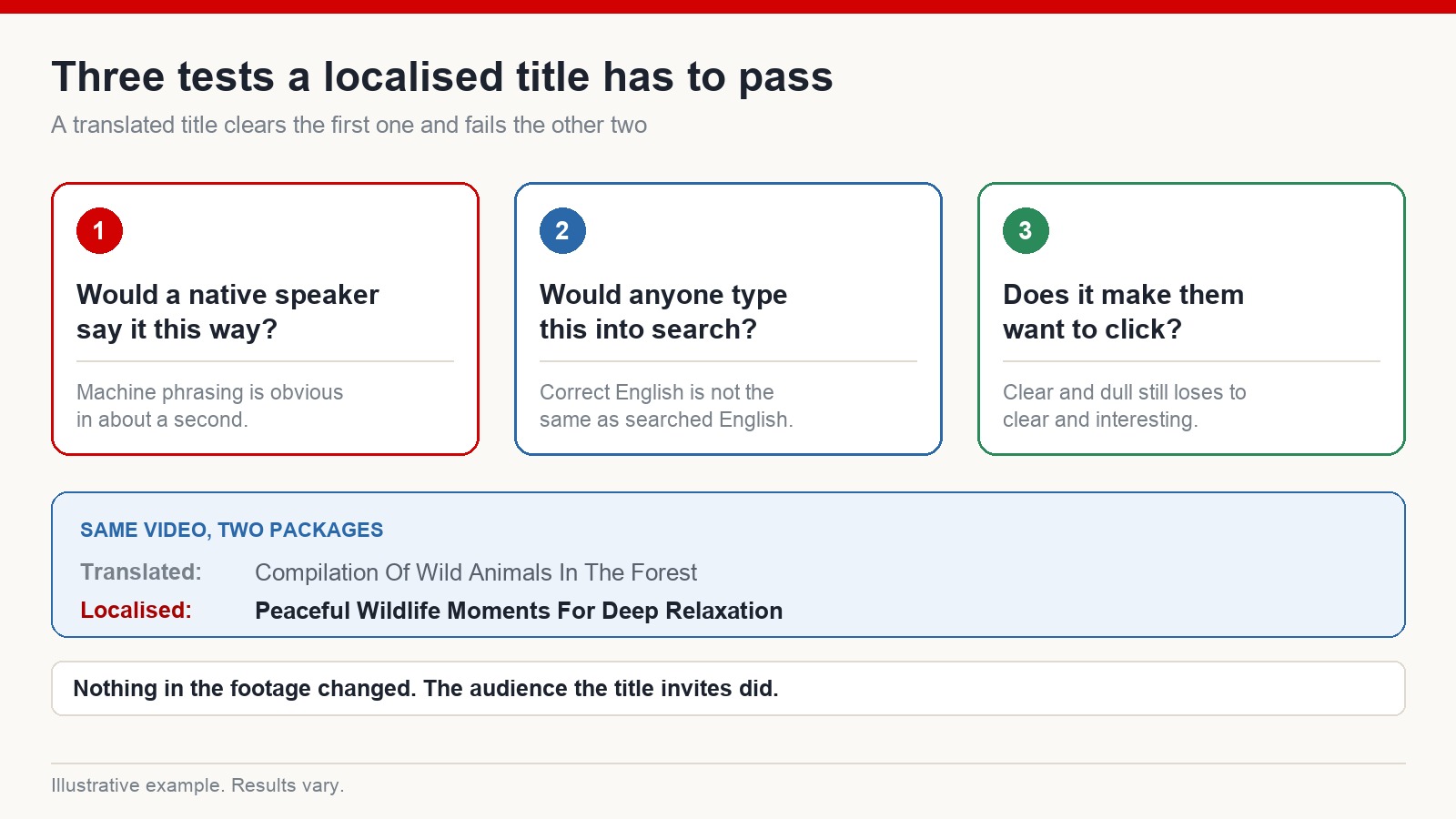
Before I publish anything now, the title has to survive three questions:
- Would a native speaker actually phrase it this way? Machine phrasing is obvious in about a second, and it reads as low effort before a viewer has seen a single frame.
- Would anyone type this into search? Correct English and searched English are different vocabularies.
- Does it give them a reason to click? Clear and dull still loses to clear and interesting.
A translated title usually clears the first question and fails the other two.
You do not need to speak the language to start
This is the part I want to be encouraging about, because language anxiety stops more people than skill ever does. You do not need fluent English, Japanese, Portuguese or Korean to build a channel for those markets. A workable process looks like this:
- Write the idea in whatever language you think in.
- Sharpen the idea until it is genuinely good.
- Use an AI tool to move it into the target language.
- Rewrite the result so it sounds like a person, not a dictionary.
That last step is the one people skip, and it is the only one that separates a localized title from a translated one. AI gives you speed. It does not give you judgment about a market it has never had to sell to.
Two families of title, and why you need both
Channels that hold up over years rarely run a single style of title. There are two families worth understanding, and they do different jobs.
The curiosity title
Emotional, slightly surprising, built to be irresistible in a feed. Something like 7 Incredible Wildlife Moments You Will Not Believe. This is the title that can spike fast when the algorithm decides to test it widely.
The demand title
Plain, specific, and built on a phrase people genuinely type. Something like Peaceful Wildlife Sounds For Deep Relaxation. This one rarely explodes. It also rarely dies, which is the whole point.
Running them as a ratio
Instead of choosing a camp, treat it as a mix. One curiosity title for every demand title is a reasonable starting point; two or three to one works if your niche moves fast and rewards novelty. The ratio matters less than the fact that you have one at all, because a channel made entirely of curiosity titles lives and dies on the feed, and a channel made entirely of demand titles never gets a breakout to build on.
Numbers that make people stop scrolling
People respond to patterns, and numbers are the most reliable pattern in a feed. On international YouTube the counts that show up again and again are 3, 5, 7, 9, 10, 15, 30, 50, 100, 150, 300, 500 and 700.
- 10 Peaceful Nature Stories
- 7 Amazing Animal Rescues
- 50 Relaxing Forest Sounds
A number gives the eye something concrete to land on while the thumb keeps moving. It is a small mechanical advantage rather than a trick, and like every small advantage it only helps when the video behind it delivers what the number promised.
Why I avoid the number 13
In a lot of Western cultures 13 carries an unlucky association. Nobody is going to close the app because they saw it, and I have no data proving it costs clicks. I still avoid it, on the same logic that I would not name a product something that reads awkwardly in the market I am selling into. When a choice is free, take the one that does not fight your audience.
Slicing: let the data write the title
Stop trying to invent titles in your head. Take them apart instead.
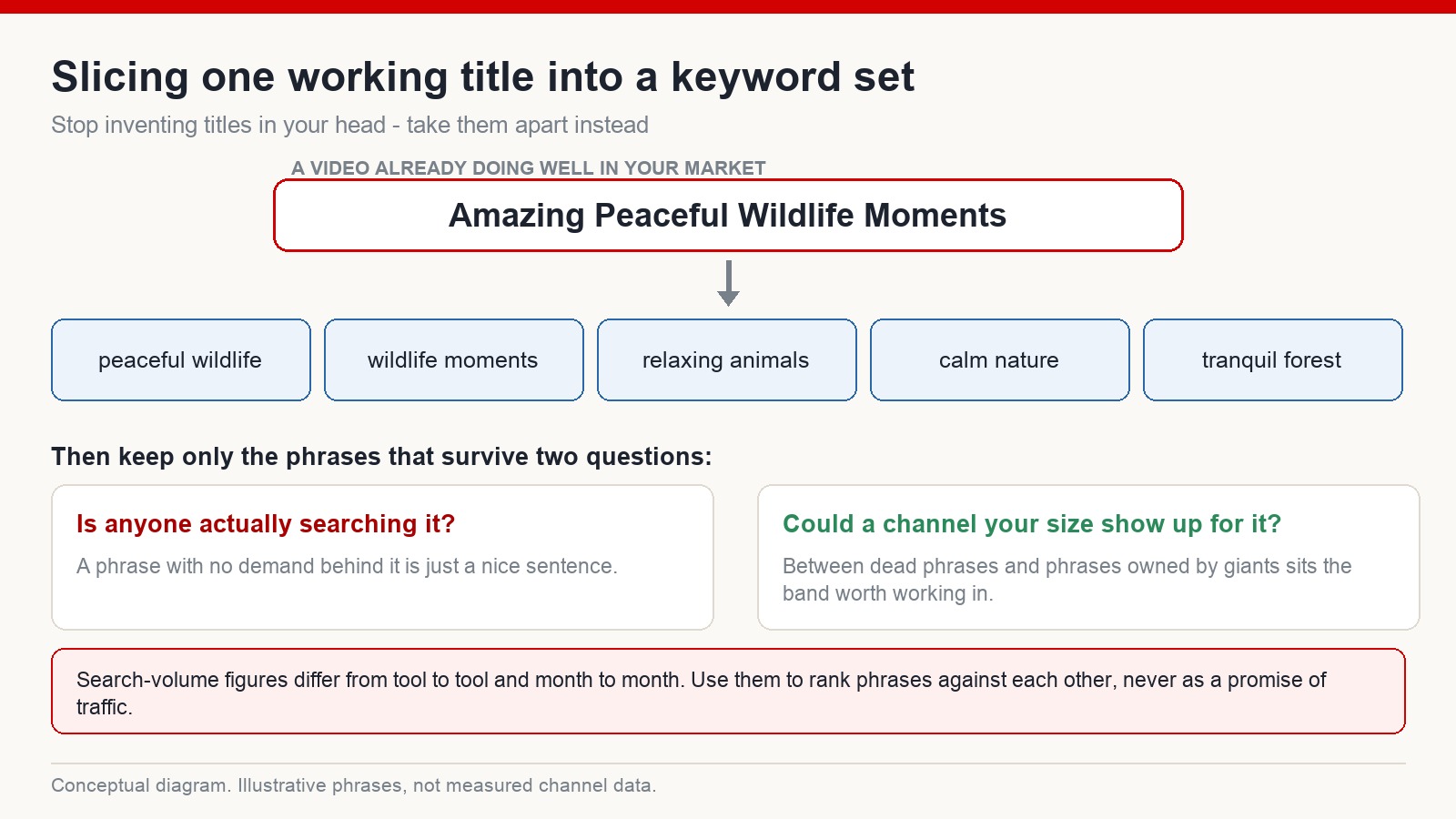
The process is three steps and takes about ten minutes:
- Find a video already doing well in your target market.
- Read its title as a piece of data, not as a piece of writing.
- Slice it into every smaller phrase it contains.
A title like Peaceful Wildlife Moments breaks apart into peaceful wildlife, wildlife moments, relaxing animals, calm nature, tranquil forest. Now you are not guessing at language, you are holding five real phrases the market already responds to.
Then filter them with two questions. Is anyone actually searching this? And could a channel your current size realistically show up for it? Between the phrases with no demand behind them and the phrases owned by channels a hundred times your size sits the band that is worth working in.
One warning on the tools: search-volume estimates differ between platforms and drift month to month. Use them to rank phrases against each other, never as a promise of traffic.
Repackaging: change the audience without changing the video
This is my favourite move in the whole discipline, because it costs nothing.
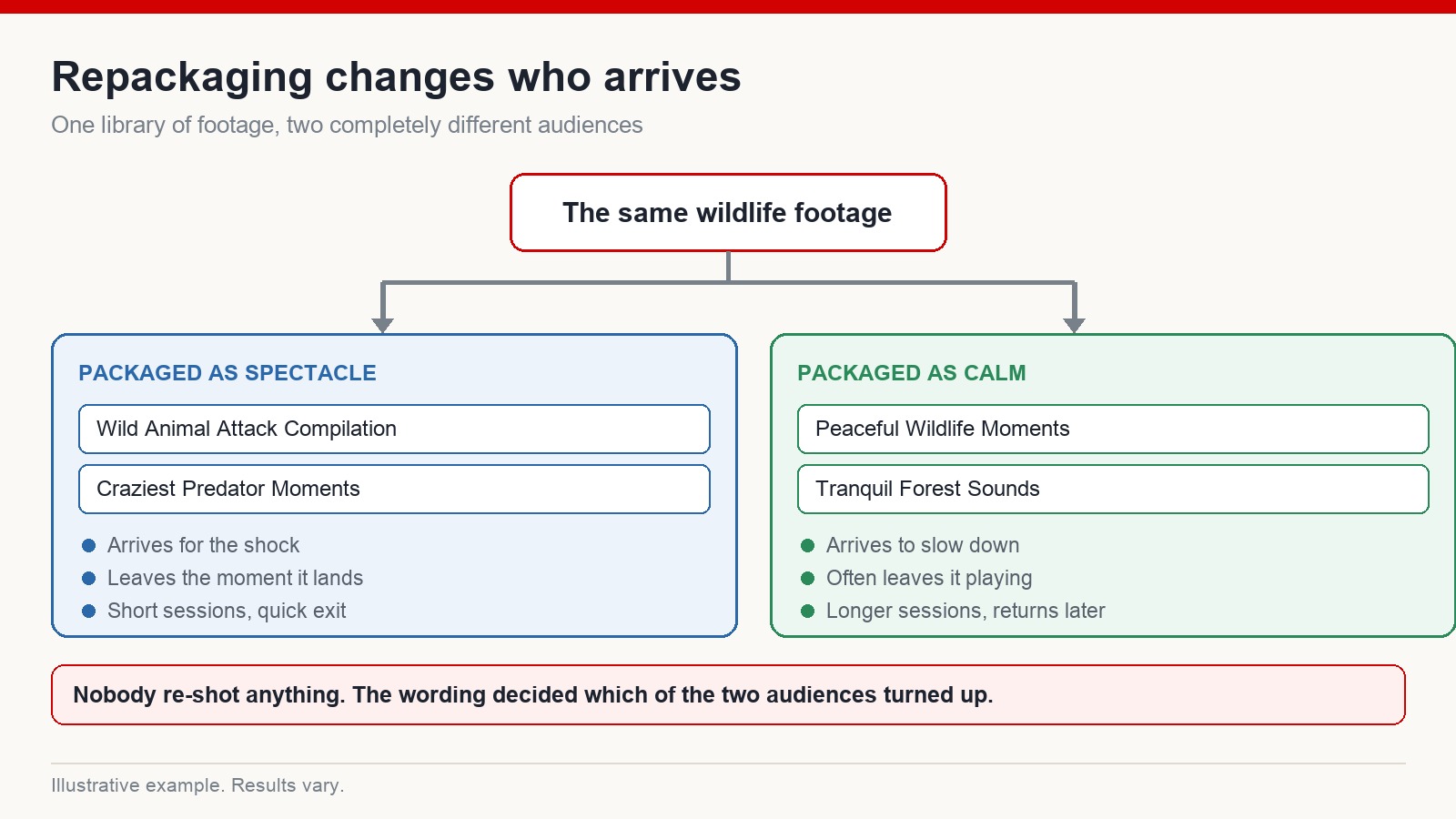
Say you have footage of animals in the wild. Package it as spectacle – Wild Animal Attack Compilation – and you invite viewers who arrive for the shock and leave the moment it lands. Package the same library as calm – Peaceful Wildlife Moments, Relaxing Nature Journey, Tranquil Forest Life – and you invite people who put it on to slow down, often leave it playing, and come back later.
Nothing in the footage changed. The wording decided which of the two audiences turned up, and those two audiences behave completely differently once they are there.
A localized title still needs a consistent brand
A good title earns the click. A recognisable brand earns the return visit. If you are running more than one channel, keep the naming structure identical across all of them so a viewer who liked one recognises the next.
Pick a mark and never bend it. If the brand is written one way, it is written that way everywhere: on the channel banner, in the title suffix, in the about section. Something like Northline (Wildlife), Northline (Nature), Northline (Forest Stories) reads as a network rather than three unrelated accounts. Tags, by contrast, are better kept entirely lowercase – they are machine input, not branding.
AI can write titles. Data decides which one ships.
AI will hand you two hundred title options in a few seconds, and some of them will be genuinely good. What it cannot tell you is which of those titles brings in an audience worth having:
- which viewer group advertisers actually compete for
- which viewer group watches to the end
- which viewer group subscribes rather than passing through
Those answers live in your own analytics and in the search data for your market. The creators I see doing well are not the ones generating the most titles. They are the ones running a loop: AI for volume, data for selection, audience psychology for the wording, brand for continuity.
Wrapping up
A title stopped being a caption a long time ago. It is the instrument that positions a video against an audience, and it influences the click, the watch time and the value of the traffic that follows.
When you localize properly, you are not moving a video into another language. You are turning one piece of footage into a product shaped for a specific group of people. That skill compounds across every video you publish afterwards, which is why I would learn it early rather than late.
The usual caveat applies, and I mean it: platform behaviour shifts, niches saturate, and results vary enormously between channels. Nothing here guarantees an outcome. It just removes a set of avoidable mistakes.
Frequently asked questions
Is localizing a title just translating it into English?
No. The goal is to use the phrasing, keywords and structure the target audience genuinely recognises and searches for. A correct translation can still be a phrase nobody types.
Should one channel run more than one style of title?
Usually yes. Balancing emotional titles against search-demand titles gives a channel both a chance at breakouts and a floor of steady traffic underneath.
Can AI replace keyword research?
It is excellent for generating options and for reading a language you do not speak. It is not a substitute for search data and your own retention numbers, which is where the decision should actually be made.
Does the number in a title really matter?
It helps the title read as concrete and scannable. It is a modest advantage, not a lever, and it does nothing if the video does not deliver what the number promised.
What matters most when working an international audience?
Not translating faster. Understanding the audience more deeply, then packaging the content in their language, their references and their habits.
If you want to go further with this, the research process behind titles – finding the market, reading the competition, and choosing the phrases before you ever open an editor – is what I teach at mmoyoutube.com.